← ProjectsPentimento

AI authority · right of reply
Skip to the written case
Interactive essay2026 · Working piece · study pending

Pentimento

Each machine-written claim shows its evidence. The person can accept it, rewrite it, or strike it, and their version leads the final page.

What I did
I framed the right of reply, designed the strike-and-rewrite interaction, built local archive processing, and wrote the participant-study protocol.
Context
Self-directed research-through-design · Independent · concept to production
Main design decision
Sovereign ink: Make the person's correction the leading text, not an annotation beside the system's sentence.
What exists
A complete first draft, reply, second draft, print, and structured-record loop.
Still unproven
Maya's edition is authored fictional research material, not participant evidence.
Try the interactionReading accepted · machine prose remains
System reading

The archive shows a decisive change in taste.

Allowed to enter the second draft · reply remains revisable
What this showsThe machine claim opens intact. A reply changes the second draft; a strike keeps the original readable above while the example correction takes the lead below.

Scale · 2 archive modes · 3 reply paths · complete revision lineageBuilt with · React · TypeScript · Vite · CSS · Browser-local computation

The situation

Software is increasingly turning personal archives into confident stories about the people inside them.

Year-in-review products and generated memory systems select patterns, name chapters, and imply causes. They usually show little evidence, communicate little uncertainty, and offer no consequential way for the person described to say: that happened, but it does not mean what you think it means.

Pentimento proposes three obligations for software that narrates a person: show the evidence, admit uncertainty, and give the subject a right of reply that changes the final artifact.

What it is

Every claim opens to the dates, titles, ratios, or absences behind it. A person can accept the reading, replace it, or strike it without supplying an alternative.

The software gets a draft. The person gets the final word.

What changed during the build

The first version was a film-taste explorer. Rebuilding it around correction made the conflict between the system's account and the person's account the centre of the interaction.

The mechanism is working. The participant study has not been run, so the project does not yet show how correction feels with someone's own archive.
The reasoning

A film-taste explorer became an argument about who tells the story.

The turn

  1. Where it started

    The project began by detecting changes in film taste. That direction risked becoming a polished movie application with timelines, recommendations, and attractive cultural data.

  2. What changed

    The original moment was the strike: the system could make a defensible interpretation, the person could reject its meaning, and the page could visibly transfer authority.

  3. Where it landed

    I rebuilt the project around one question: when software writes about a person, who controls the final text? Film history remains the first archive because it is portable and easy to read, but the contribution is a grammar for correction, not an analysis of taste.

How the interaction works

The product opens inside a contested first draft. Every consequential sentence must show its evidence and accept one of three replies before the second draft can be settled.

  1. Open a claim to inspect the dates, titles, patterns, absences, ratios, or arithmetic behind it.
  2. Let the reading stand, choose another defensible framing, or strike it without being forced to write a replacement.
  3. When struck, watch the machine sentence recede while the person's correction rises into the leading typographic voice.
  4. Reopen any reply and revise it. No consequential decision becomes irreversible because of one click.
  5. Settle the second draft only after every claim has received a reply.
  6. Print or download a record that keeps the evidence, the withdrawn language, and who wrote what, without exporting the raw archive.

The system underneath

  1. Evidence
    The archive stays factual

    Dates, titles, returns, gaps, and literal computations answer why a reading was proposed. Causes are never treated as observable facts.

  2. Reply
    Disagreement changes the document

    Let stand, read differently, and strike are all successful paths. Each choice visibly changes the prose and remains revisable.

  3. Record
    The dispute survives settlement

    The second draft, print output, and session record keep the machine's underpainting visible beside the person's correction.

Considered, then dropped

  • Movie tracker

    A better timeline or recommendation layer would improve the domain while leaving the authorship asymmetry untouched.

  • Comment beside the claim

    A comment keeps the person at the margin while the machine's sentence remains the document's authority.

  • Delete the wrong reading

    Deletion would hide that the system made the claim and erase the history of the disagreement.

The correction, live

One machine-written claim through its full reply.

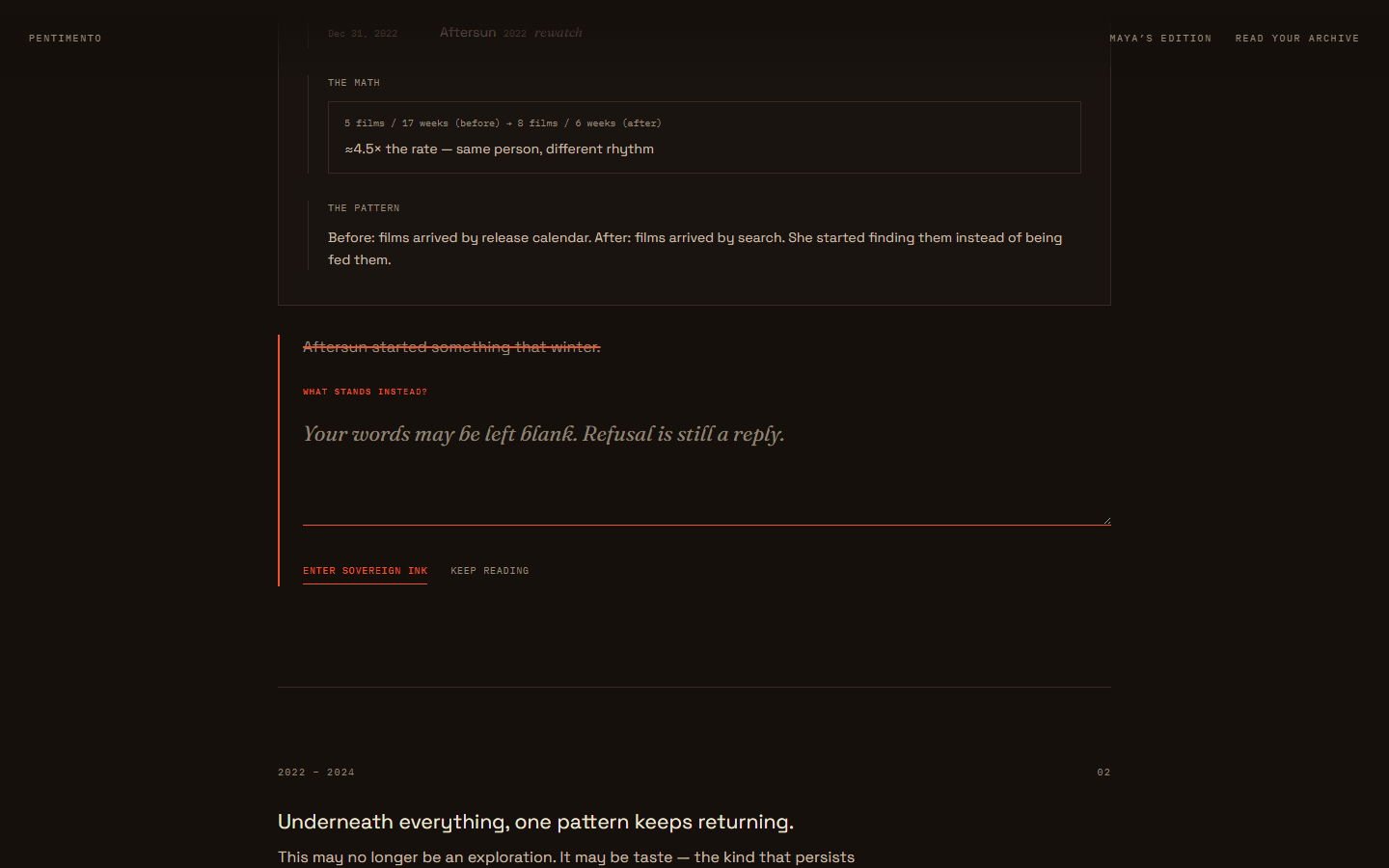
Maya's first draft: three machine-written sentences remain as claims, each underlined for reply.
The contested draftMaya's first draft, written from her public film diary. Three sentences remain as claims the subject can answer.
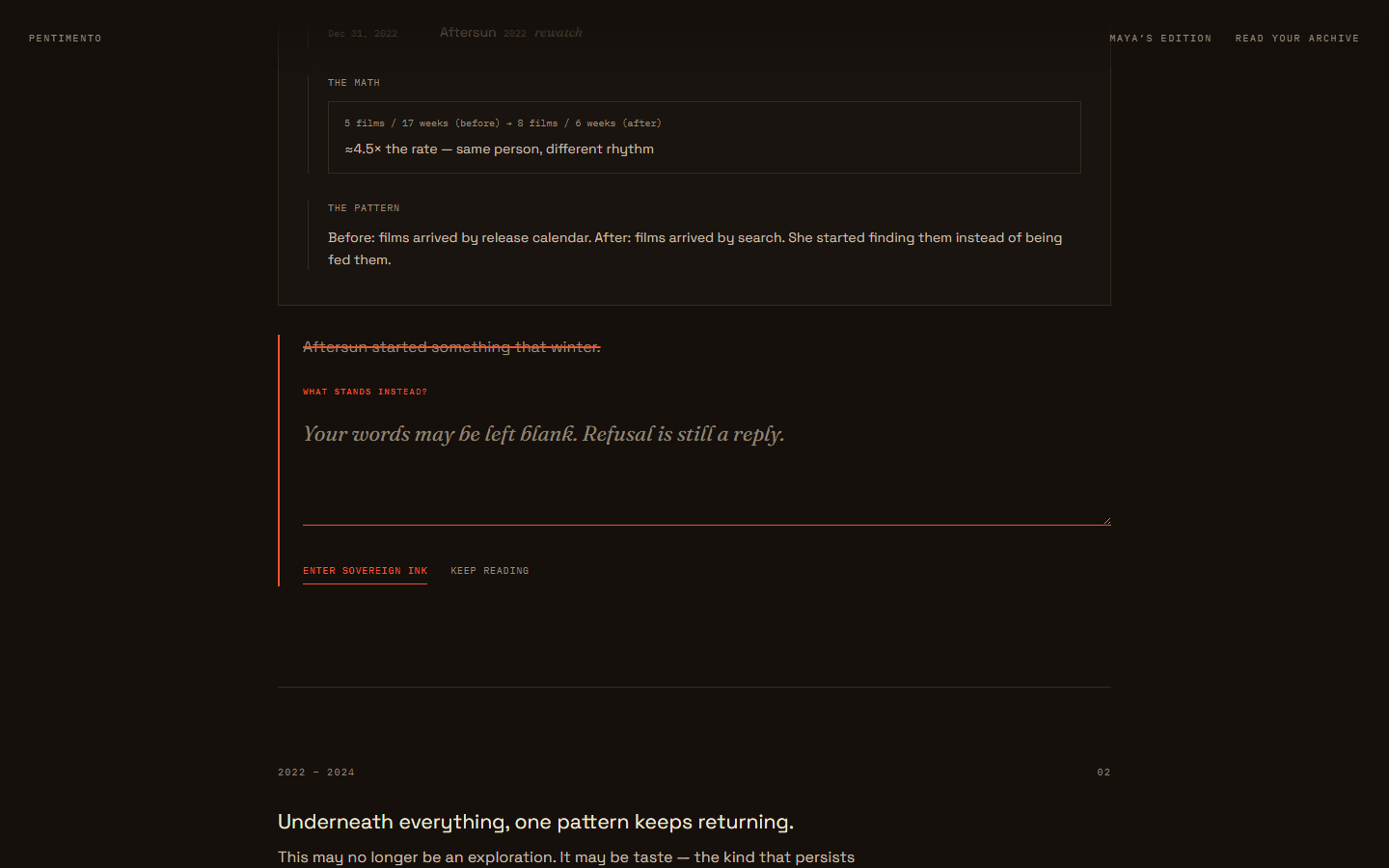
A claim opened: the evidence behind the machine's reading, with the reply options visible.
Evidence shownOpening a claim shows what the software drew on. Maya is fictional, staged from authored material; no participant data exists.
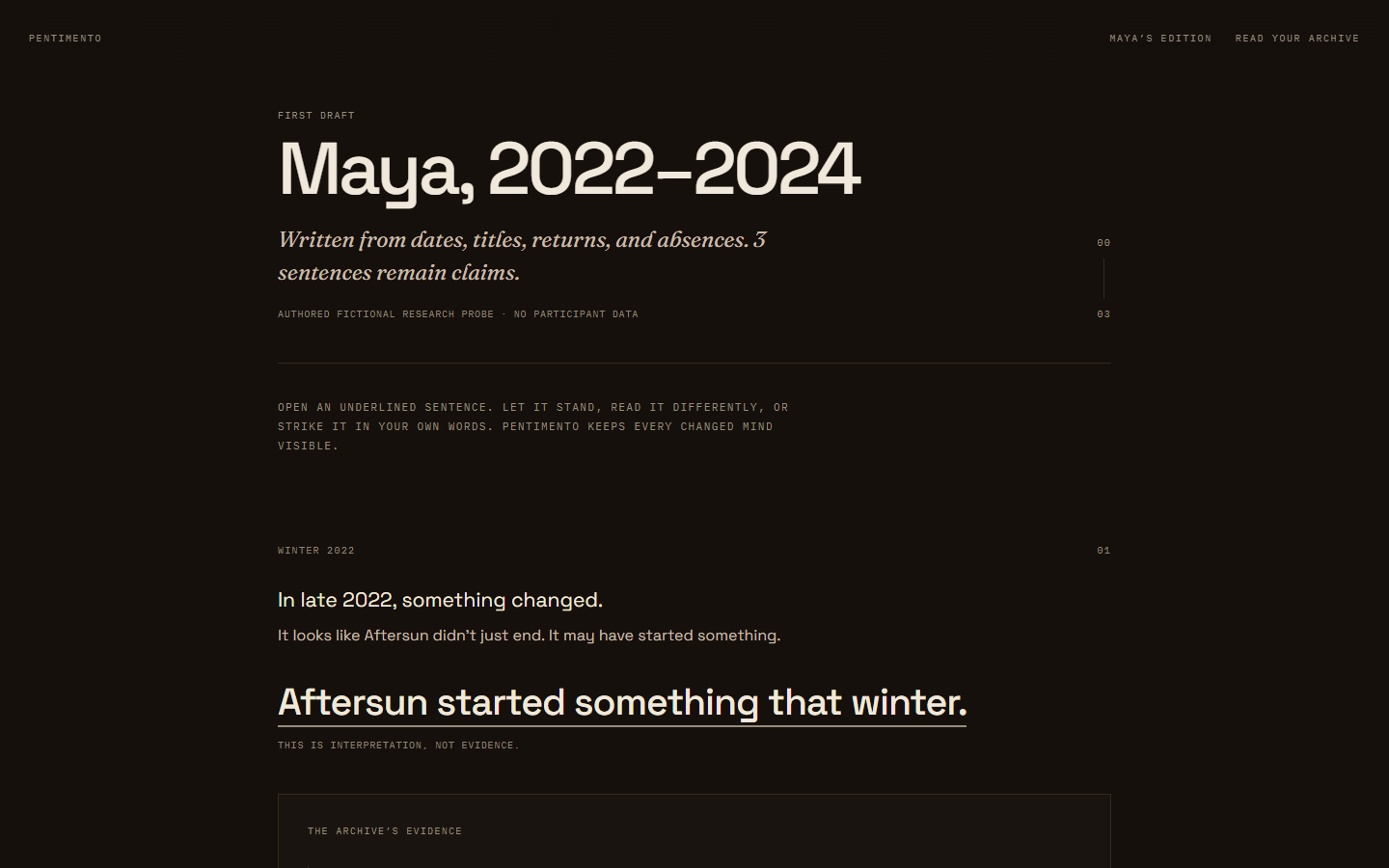
The machine's sentence struck through; the person's correction now leads the passage.
StruckThe machine's sentence struck: its account recedes and Maya's correction takes the reading.
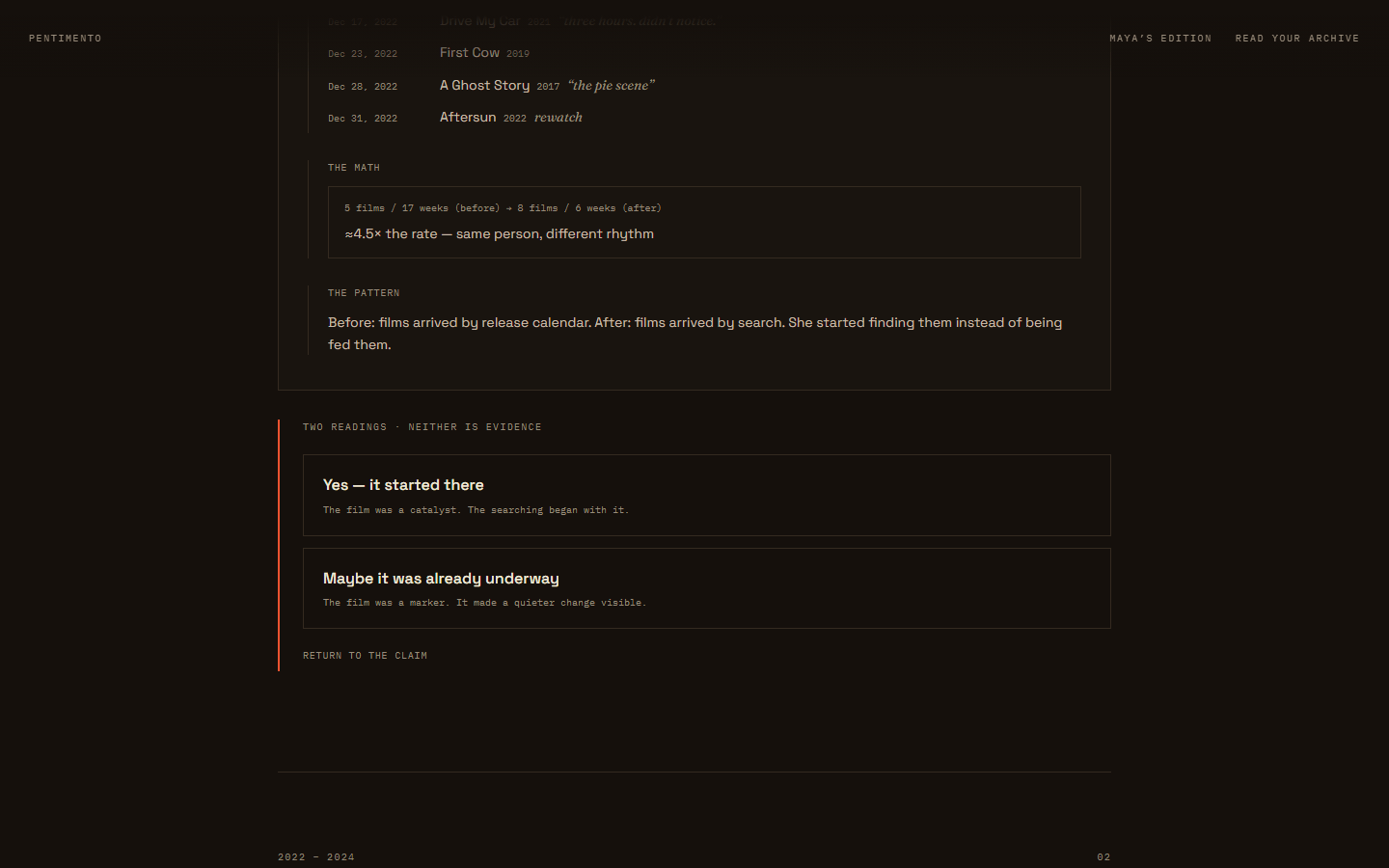
The settled second draft, with the person's version leading the document.
The final pageThe settled second draft: the person's account leads, the machine's reading is visibly overruled.

Captured from the live artifact, 2026. The embedded demonstration above remains the primary way to inspect it.

The record

Decisions and open questions.

Sovereign ink

Make the person's correction the leading text, not an annotation beside it.

The interface shows that the represented person outranks the system's account of them.

Visible withdrawal

Keep rejected language as a struck underpainting.

The system yields without quietly rewriting the fact that it made the claim.

Designed refusal

Decline to interpret archives below explicit evidence thresholds.

Insufficient material produces no chapter instead of a thin but confident story.

Local archive boundary

Compute a real Letterboxd CSV entirely in the browser.

The raw personal archive is never uploaded or included in the shareable session record.

Built and working
  • A complete first draft, reply, second draft, print, and structured-record loop.
  • Inspectable evidence and uncertainty choices for every consequential claim.
  • Let stand, reframe, strike, blank refusal, revise, undo, and underpainting paths.
  • A fictional demonstration edition plus a client-side real-archive mode with explicit refusal thresholds.
Not yet proven
  • Maya's edition is authored fictional research material, not participant evidence.
  • The written participant protocol has not been run, so no comprehension, trust, or correction-outcome result is claimed.
  • The Let it stand / Read it differently / Strike it wording was stress-tested against synthetic scenarios before any human session. Those scenarios are preparation, not evidence, and no participant data exists yet.
  • The corrections corpus is intentionally empty until consented sessions produce real corrections.

Next test

Run the right-of-reply study with 8–12 Letterboxd users.

Participants will work with their own local archive, think aloud through computed chapters, reply to readings, review the second draft, and choose what to share. The study records what each reply meant to the person and what, if anything, they changed, not whether the archive's reading was right.

What would countA high strike rate is not failure. The important signal is whether refusal feels possible, consequential, and trustworthy a week later.

AI assisted ideation, critique, source discovery, and code iteration. Final concept selection, research framing, design decisions, editing, implementation, and authorship are Tanishk's.

Next

A correction fixes one claim. Atlas keeps the record of every change a rule went through.

Rule testing toolAtlas

A tool for testing a design rule against three very different examples. Keep the rule, change it, or challenge it and see a record of how your thinking evolves.

Also: Daynero →

← Back to projects