← ProjectsAtlas

Rule testing · revision history
Skip to the written case
Rule testing tool2026 · Working tool · audit open

Atlas

Write a provisional rule, test it against three very different cases, and keep a record of every change and the case that caused it.

What I did
I reframed a 33-answer library as a three-case rule test, then built its revision trace, persistence, export, and evidence audit.
Context
Self-directed research-through-design · Independent · concept to production
Main design decision
Preserved lineage: Require visible wording changes for refine and fracture, so the final rule carries every case that produced it.
What exists
A complete rule test: edit the claim, carry it through the three cases, and export a record with every wording change.
Still unproven
The three pressure cases are authored and intentionally adversarial, not sampled from practice.
Try the interactionLightbox · 1 of 3

Hold keeps this wording. To refine or fracture, edit the rule first.

Lineage

  1. Starting rulewritten

    Outside tap may dismiss a reversible overlay.

What this showsRefine and fracture require revised wording before they can be committed. The trace keeps the case that caused every change.

Scale · 1 rule test · 3 pressure cases · 33 supporting examplesBuilt with · React · TypeScript · Vite · Framer Motion · Tailwind CSS

The situation

Design guidance often arrives as a finished sentence with its pressure history removed.

A principle can sound universal when the cases it fails, the assumptions it carries, and the revisions it survived remain invisible. Applying that sentence elsewhere then becomes recall rather than judgment.

Atlas asks whether design reasoning can become inspectable without turning into an answer generator. What matters is not the final rule alone but the visible record of the rule changing under pressure.

What it is

At each case, the visitor chooses hold, refine, or fracture. A change in judgment requires new wording, and the earlier version stays in the trace.

The useful record is the case that forced each edit, not a final rule presented as universally correct.

A rule is easier to trust when you can see which case changed it.

What changed during the build

Atlas began as 33 written answers. Moving one editable rule to the centre turned the visitor from a reader into the person doing the revision.

The interaction is built, but it has not been tested with learners and does not prove transfer.
The reasoning

Thirty-three written answers became supporting material for one participatory test.

The turn

  1. Where it started

    The first Atlas centered a library of 33 completed interaction-design arguments. The writing was useful, but the visitor remained a reader of somebody else's reasoning.

  2. What changed

    The project claimed to teach transferable judgment while giving the visitor nothing to transfer. A library could illustrate reasoning, but it could not make revision happen.

  3. Where it landed

    I moved a rule test to the center: write a provisional principle, carry it through deliberately distant situations, rewrite it when necessary, and keep the full lineage. The corpus now supports the activity instead of impersonating proof.

The system underneath

  1. Claim
    Begin with explicit wording

    A suggested principle is editable before pressure begins, making the visitor's assumption concrete enough to test.

  2. Pressure
    Increase adversarial distance

    The sequence moves from a similar case, to a consequential one, to one where the input itself is different, so an early success cannot pass for transfer.

  3. Trace
    Preserve every change

    Hold, refine, and fracture remain distinct; changed wording requires a visible rewrite and earlier language never disappears.

How the interaction works

One familiar question, 'When should tapping outside a dialog close it?', moves through three cases chosen for increasing distance, not difficulty.

  1. Edit a suggested starting rule until it states what you currently believe.
  2. Apply it to a low-consequence lightbox and choose whether the rule holds (it works as written), needs refinement (same idea, sharper wording), or fractures (the case breaks it and the rule must be rewritten).
  3. Carry the current wording into a high-consequence financial transfer and rewrite it if the stakes expose a missing condition.
  4. Carry it to switch access, where tapping outside a dialog does not exist as an input at all.
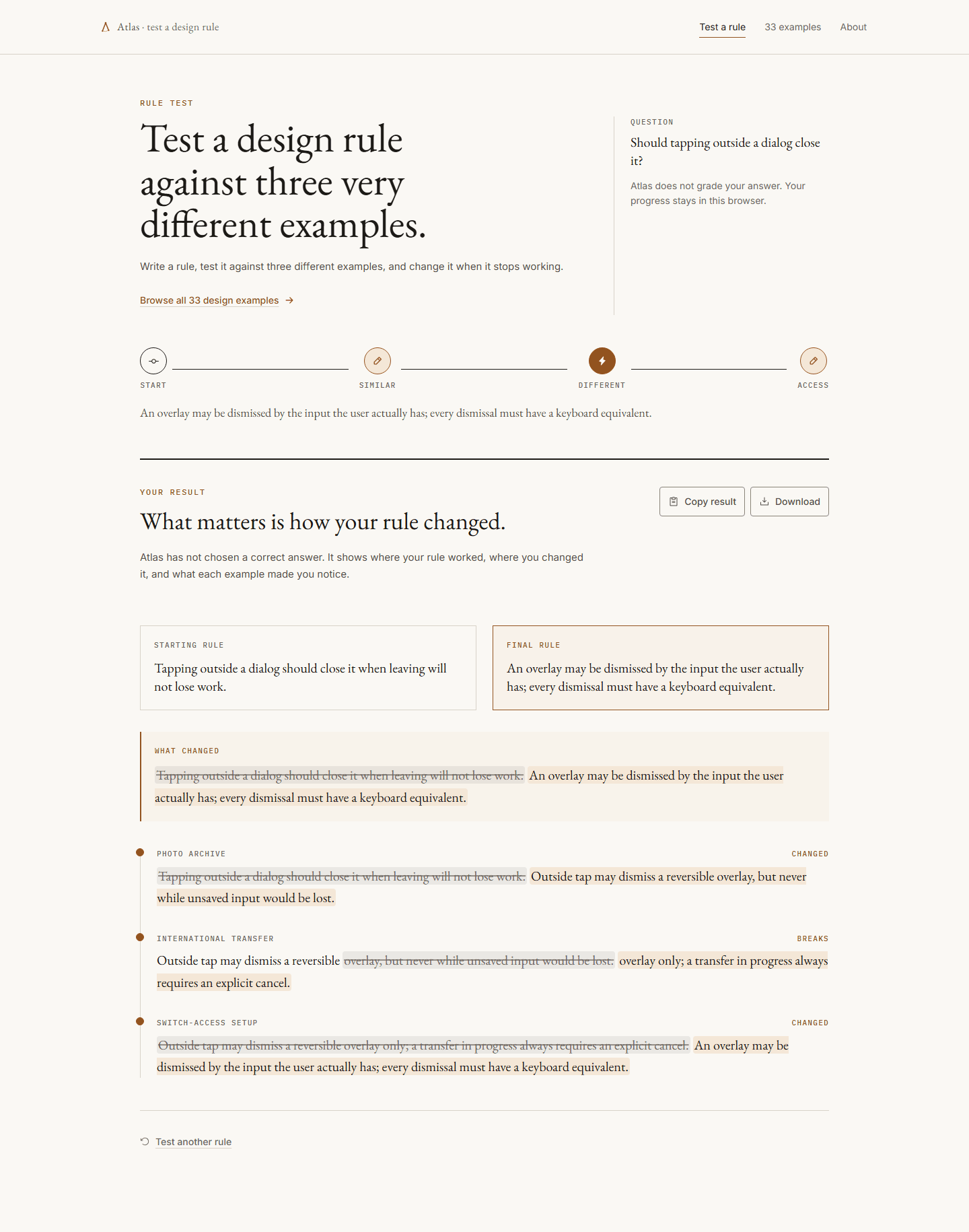
  5. Compare the first and final language, inspect every branch, and see exactly which case caused each change.
  6. Copy or download the stress trace; restarting rotates the suggested rule without changing the question or evidence sequence.

Considered, then dropped

  • Answer library as product

    It displayed finished reasoning while keeping the visitor outside the act of revision.

  • Generated best practice

    An answer generator would replace judgment with authority and hide the cases behind the recommendation.

  • Three similar examples

    Repeated near cases would reward consistency without testing whether the principle transfers.

One real run

A rule carried through three very different cases, in the live tool.

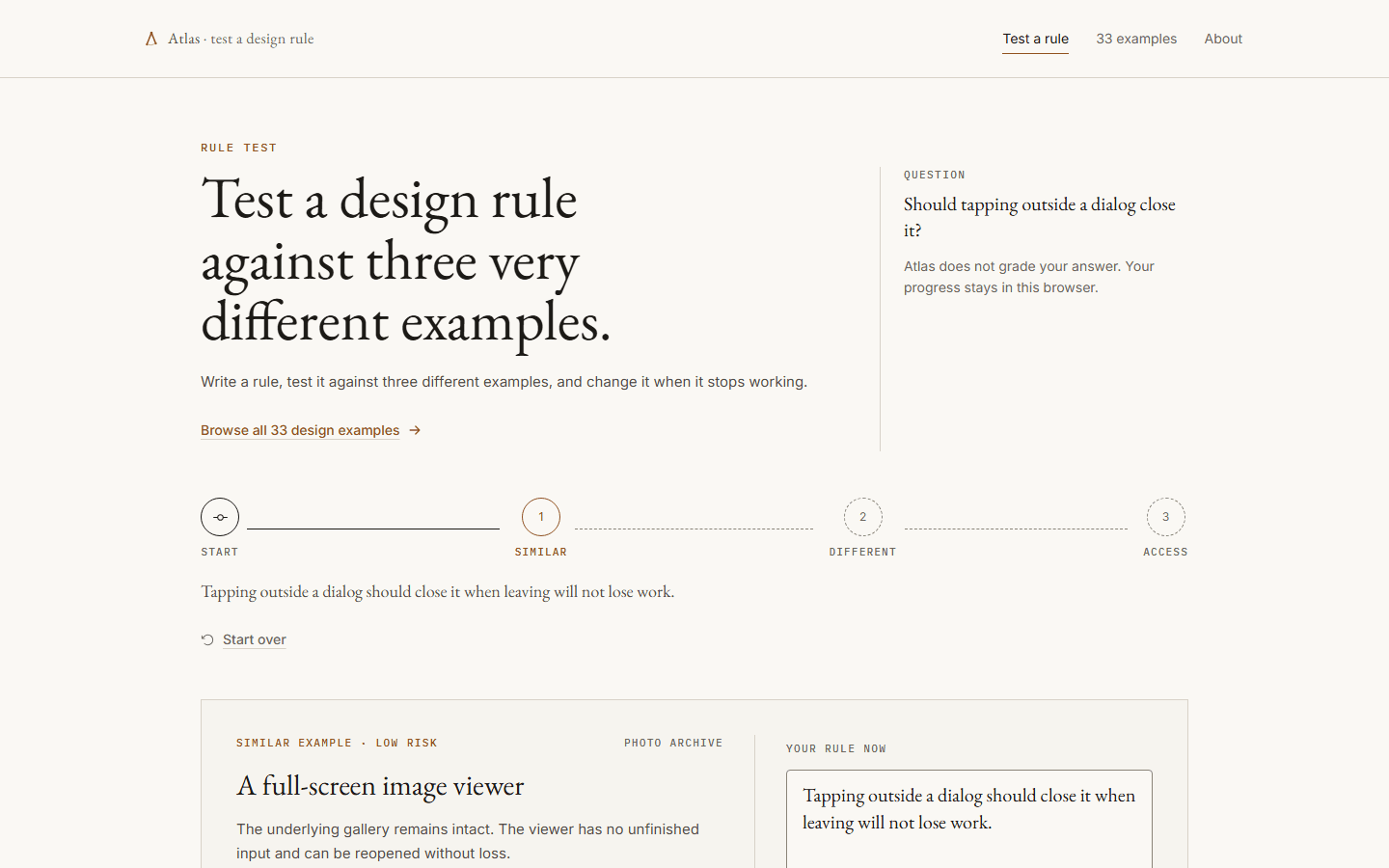
The Atlas rule test: the starting rule editable in place, with the lightbox case ready below.
The starting ruleThe test opens with a suggested rule, editable before any pressure, so the assumption being carried is explicit.
The completed trace: the starting rule, a refinement after the lightbox, a rewrite after the financial transfer, and the final wording after switch access.
The lineageA completed run: hold, refine and fracture each demanded rewording, and the trace keeps which case caused every change.

Captured from the live artifact, 2026. The embedded demonstration above remains the primary way to inspect it.

The record

Decisions and open questions.

Preserved lineage

Require visible wording changes for refine and fracture.

The final answer carries the cases and revisions that produced it.

Adversarial distance

Move from lightbox to transfer flow to switch access.

The rule encounters different stakes and finally a different event model.

Motion follows reasoning

Animate only case entry, branch change, and trace construction.

Previously read evidence stays stable while the reasoning visibly moves.

Corpus as editorial support

Label four recurring answer styles as authored organization, not taxonomy.

The 33 examples remain useful without being presented as validated research evidence.

Built and working
  • A complete rule test: edit the claim, carry it through the three cases, and export a record with every wording change.
  • Persistent browser state and addressable routes with explicit focus movement.
  • W3C and Microsoft accessibility guidance anchoring the three cases without deciding the verdict.
Not yet proven
  • The three pressure cases are authored and intentionally adversarial, not sampled from practice.
  • The mechanism has not been tested with learners, so it does not prove that transferable judgment occurred.
  • Three priority examples were audited against authoritative sources. The audit of the broader 33-example corpus is still open.

Sources

Next test

Extend the audit to the corpus, then study actual revision behavior.

Extend the source audit from the three priority examples to the 33-example corpus and fix any reversed or drifting examples it finds, then compare designers who read a principle with designers who carry one through the stress trace.

What would countLook for more conditional final rules, accurate recall of why wording changed, and transfer to a fourth case, not agreement with Atlas's authored examples.

AI assisted ideation, critique, source discovery, and code iteration. Final concept selection, scenario design, design decisions, editing, implementation, and authorship are Tanishk's.

Next

A rule should answer to evidence. Design or Disaster is where that evidence gets marked.

Interface critique toolDesign or Disaster

A tool for critiquing interfaces with evidence. Mark a part of a screen, explain how it affects your judgment, then compare your verdict with five authored perspectives.

Also: Pentimento →

← Back to projects