← ProjectsInvisible Interfaces

Offscreen work · return receipt
Skip to the written case
Case 04 · Interface research2026 · Complete · v1.0

Invisible Interfaces

A staged restoration runs only while the tab is hidden, then shows what changed, what did not, and how to discard the result.

What I did
I framed the exhibition, designed its five-scene sequence and return receipt, and built the Page Visibility interaction.
Context
Self-directed research-through-design exhibition · Independent · concept to production
Main design decision
Accountable return: When work leaves the screen, the return says what changed, what stayed untouched, whether anything left the device, what the system could not know, and how to discard the result.
What exists
A causal hide, pause, resume, early-return, completion, and accountable-return sequence.
Still unproven
The browser stages authored work; it does not repair a real archive or run a deployed autonomous agent.
Try the interactionScope visible · no work started
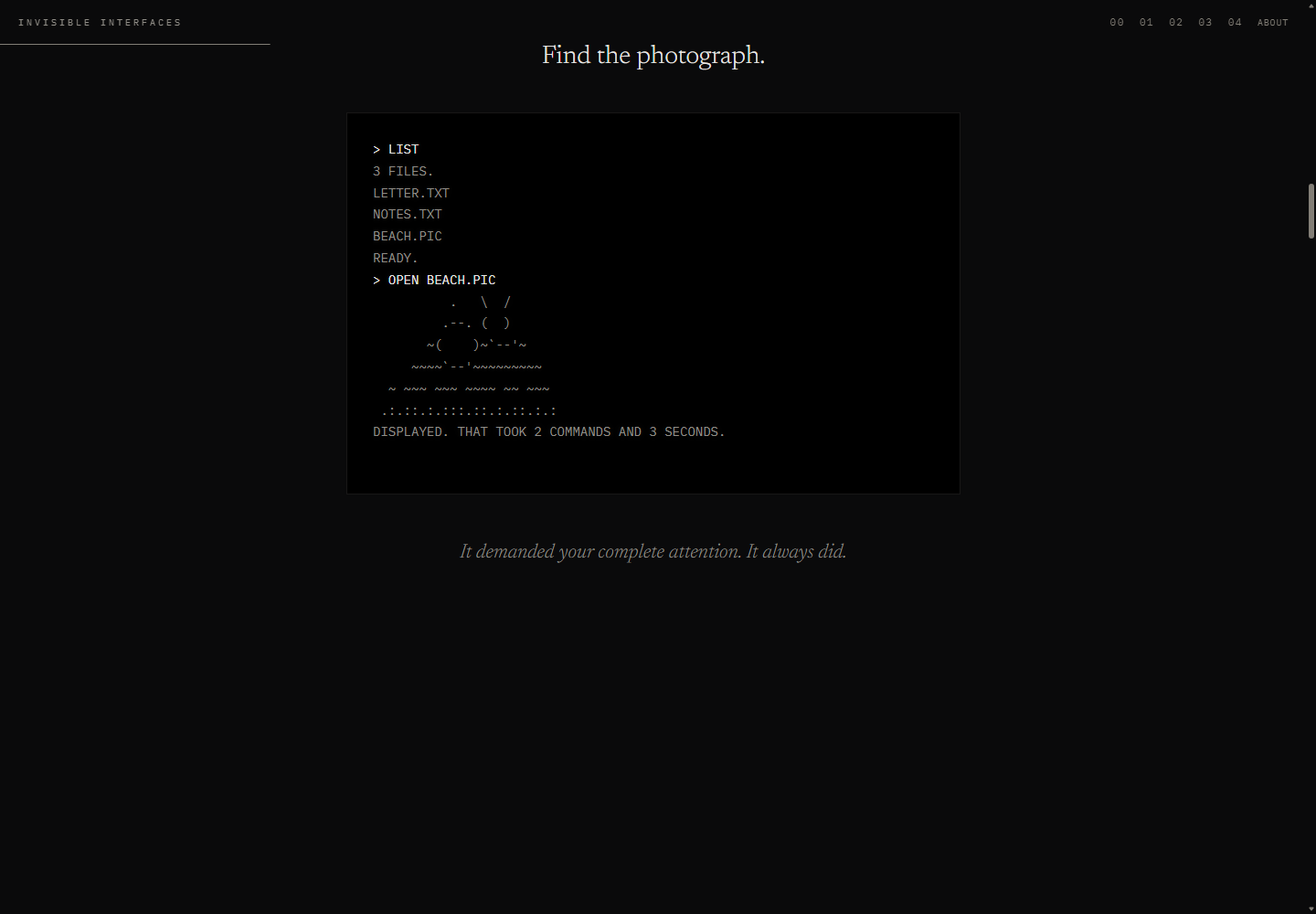
The demanded-attention terminal scene, before work is delegated.
Before · the work is still visible

Repair dust and scratches. Preserve composition and the original. Do not infer people, place, or date. You may discard the result.

What this showsThis is a staged browser work, not a deployed restoration system. The receipt below is the artifact the project argues for.

Scale · 5 scenes · 1 repeated task · causal absence loopBuilt with · Next.js · TypeScript · Motion · Tailwind CSS · Page Visibility API

The situation

Interfaces require less visible effort, but invisible work is not automatically trustworthy.

Software moved from syntax to pointing, touching, asking, prediction, memory, and delegation. That change can feel like relief. It can also move decisions into systems that act while nobody is watching.

I wanted to test what should replace continuous supervision. The project argues for a clear authority boundary before work begins and an accountable receipt when attention returns.

What it is

The first version used a progress bar. I removed it and made absence the input: the task stops while the page is visible and advances while the tab is hidden.

On return, the interface shows the result, unchanged areas, a boundary, and a discard action.

Leaving starts the work. Returning starts the audit.

What changed during the build

Removing the progress bar shifted the design problem from waiting to returning. The receipt became the part that needed the most detail.

This is a staged browser exhibition, not an autonomous restoration system or a usability result.

The reasoning

Absence became the event instead of the gap between events.

The turn

  1. Where it started

    A normal progress bar would let the visitor stay and watch a theatrical representation of invisible work. The experience would talk about delegation while rewarding supervision.

  2. What changed

    If absence mattered to the argument, it had to matter causally to the interface. Leaving could not be decorative; hidden time had to be the input that advanced the task.

  3. Where it landed

    The restoration refuses to progress while the page is visible. Each interval away completes one bounded movement. Returning early pauses the unfinished work and makes that interruption part of the record.

How the interaction works

The same beach photograph travels through five relationships with computing. The task stays stable while visible operation collapses, ending in a restoration that cannot finish while anyone is looking.

  1. Find the photograph through a terminal that demands syntax, error recovery, and continuous attention.
  2. Move through pointing, touching, asking, and prediction as visible friction falls.
  3. See the system begin to remember and anticipate before receiving an explicit request.
  4. Entrust a bounded restoration with stated limits and an available demonstration path.
  5. Leave the tab. Hidden time advances one bounded movement. Returning early pauses what remains.
  6. Inspect the original and restored image, the work receipt, the authority boundary, the discard path, and the local attention receipt.

Considered, then dropped

  • Animated progress theater

    A visible bar would simulate invisible labor while leaving the visitor in the role of supervisor.

  • Agent dashboard

    More status chrome would make the system look busy without clarifying its authority or accountability.

  • Silent analytics

    Measuring attention without returning the record would repeat the opacity the essay criticizes.

The record

Decisions and open questions.

Causal absence

Use hidden time as the task input rather than as an animation trigger.

The visitor must enact delegation to understand the argument.

Accountable return

Describe what changed, what stayed untouched, whether anything left the device, what could not be known, and how to discard it.

Completion communicates responsibility instead of merely announcing success.

Returned gaze

Report the essay's own usage: time spent on the opening, terminal effort, reverse scrubs, and navigation.

The work applies its transparency demand to itself.

No remote observer

Keep the attention ledger in session storage and remove it when the tab closes.

The receipt can teach the argument without becoming an analytics system.

Built and working
  • A causal hide, pause, resume, early-return, completion, and accountable-return sequence.
  • A keyboard- and touch-accessible original/restored comparison.
  • A disclosed fallback so browser capability never traps the visitor.
  • Automated walkthroughs for the opening, terminal, morph, anticipation, absence, keyboard, mobile, reduced-motion, About, and 404 paths.
Not yet proven
  • The browser stages authored work; it does not repair a real archive or run a deployed autonomous agent.
  • The project investigates an experience, not operational safety or participant outcomes.
  • The local attention receipt is an interaction argument, not a general analytics model.

Next test

Move the grammar into a real delegated workflow.

Apply the same boundary to a task where changes have real consequences, such as bulk editing, financial categorization, archive repair, or document transformation. Test whether people can predict what the work will touch before leaving, and audit the result when they return.

What would countA trustworthy return should reduce the need for continuous supervision without reducing the person's ability to inspect, reverse, or contest the work.

AI assisted ideation, critique, and code iteration. Final concept selection, design decisions, writing, visual direction, implementation, and authorship are Tanishk's.

Next

Once work returns, someone has to judge it. Design or Disaster makes that judgment show its evidence.

Interface critique toolDesign or Disaster

A tool for critiquing interfaces with evidence. Mark a part of a screen, explain how it affects your judgment, then compare your verdict with five authored perspectives.

Also: Pentimento →

← Back to projects