← ProjectsAthena

Learning · evidence after the attempt
Skip to the written case
Case 02 · Learning product2026 · Working prototype · demo available

Athena

Close the source, explain the idea in your own words. The prototype's Explain Back reports what the explanation demonstrated and what it missed. A four-person team project, built as a working prototype.

What I did
Team project with Nishtha, Anushrutha and Trisha. My contribution: research synthesis, product and interaction design, and the working prototype.
Context
Team project · Team Folio · with Nishtha, Anushrutha and Trisha
Main design decision
Report activity and mastery separately: Never turn completion, confidence or a self-rating into a mastery percentage; show the evidence state as Solid, Developing, Review or Not Tested.
What exists
A working prototype: React 19 front end, Express 5 and SQLite server, local Ollama models, Zod-validated source and citation checks.
Still unproven
No learning-outcome study has been run: no effect size, retention gain or delayed-recall result is claimed.
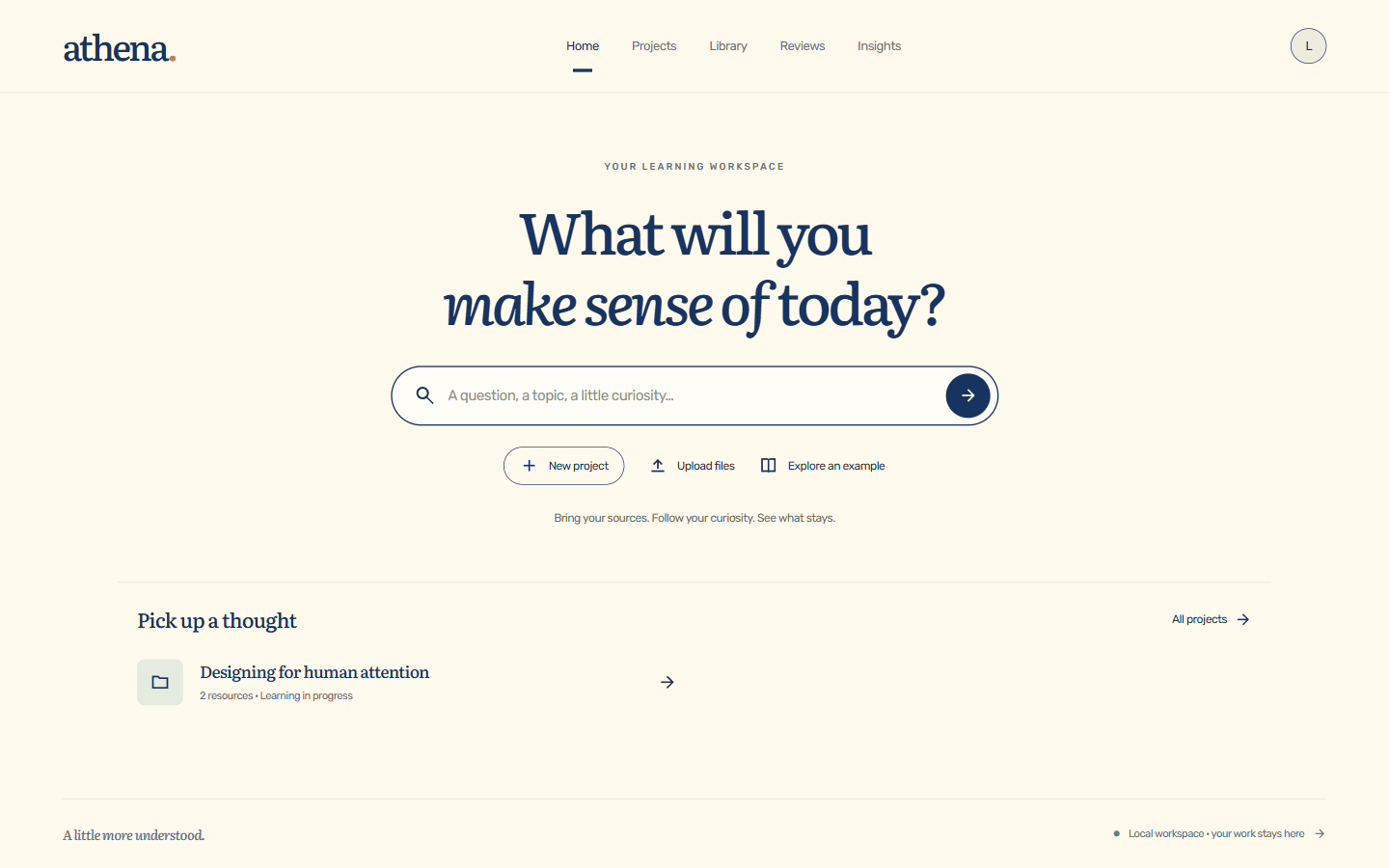
Athena's workspace home: one project holding its resources, notes, review and insights.
The workspace, workingAthena's home in the working prototype. One project holds its resources, notes, review and insights, so context is never rebuilt across tools.

Scale · Working prototype · 18/18 acceptance checks · 11 core tests · 10 API checks · 3 review modesBuilt with · React 19 · React Router · Vite · Express 5 · Node 22 · SQLite · PDF.js · Ollama · Zod · Playwright

The review loop, in the working prototype

Find and organise a resource, learn it with notes beside it, then review. There, an attempt turns into evidence.

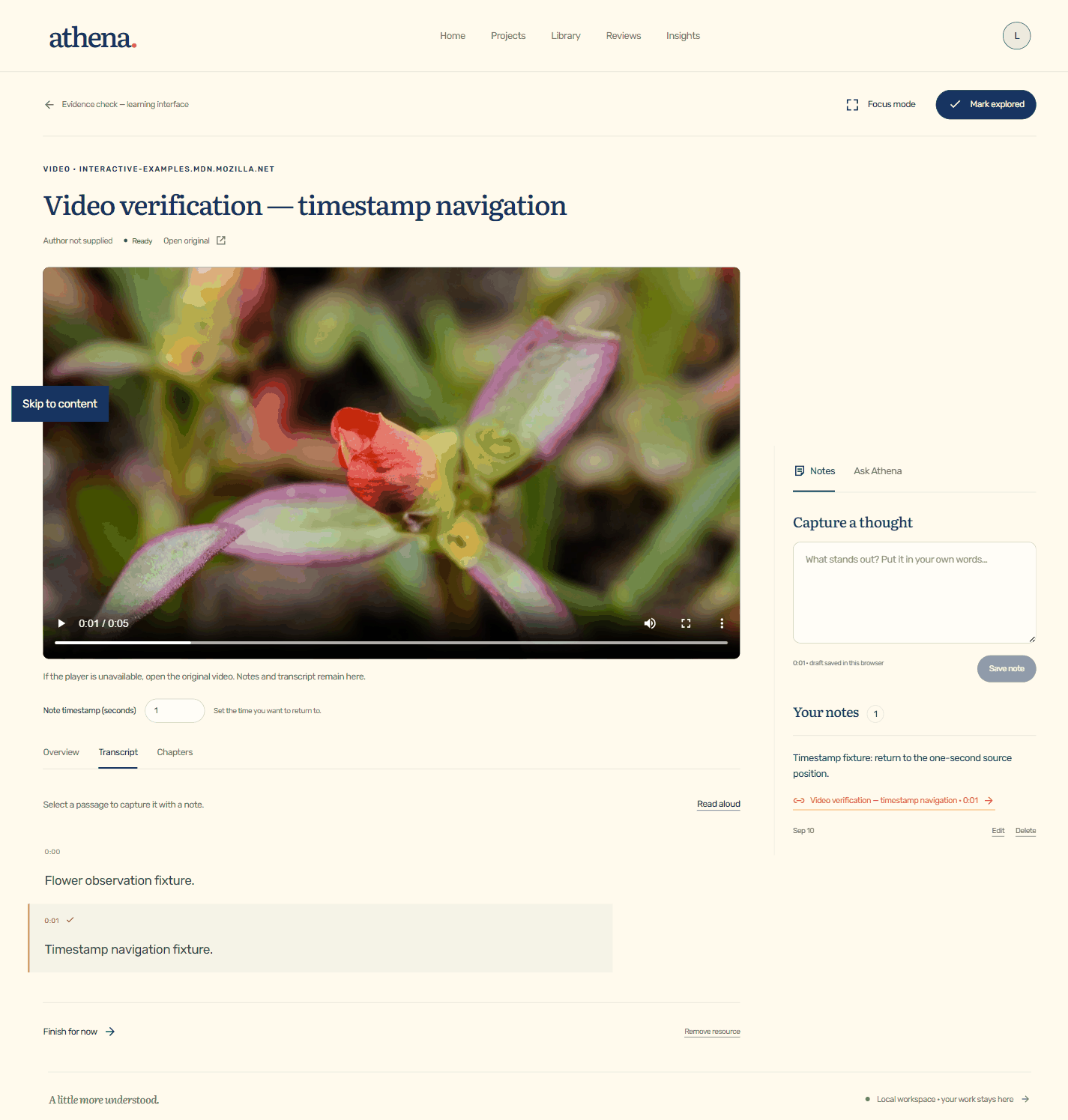
Athena's reader: a source open with contextual notes and source-grounded help beside it.
Learn & captureThe resource, the learner's notes and the source-grounded help stay in one place, so nothing has to be reassembled later.
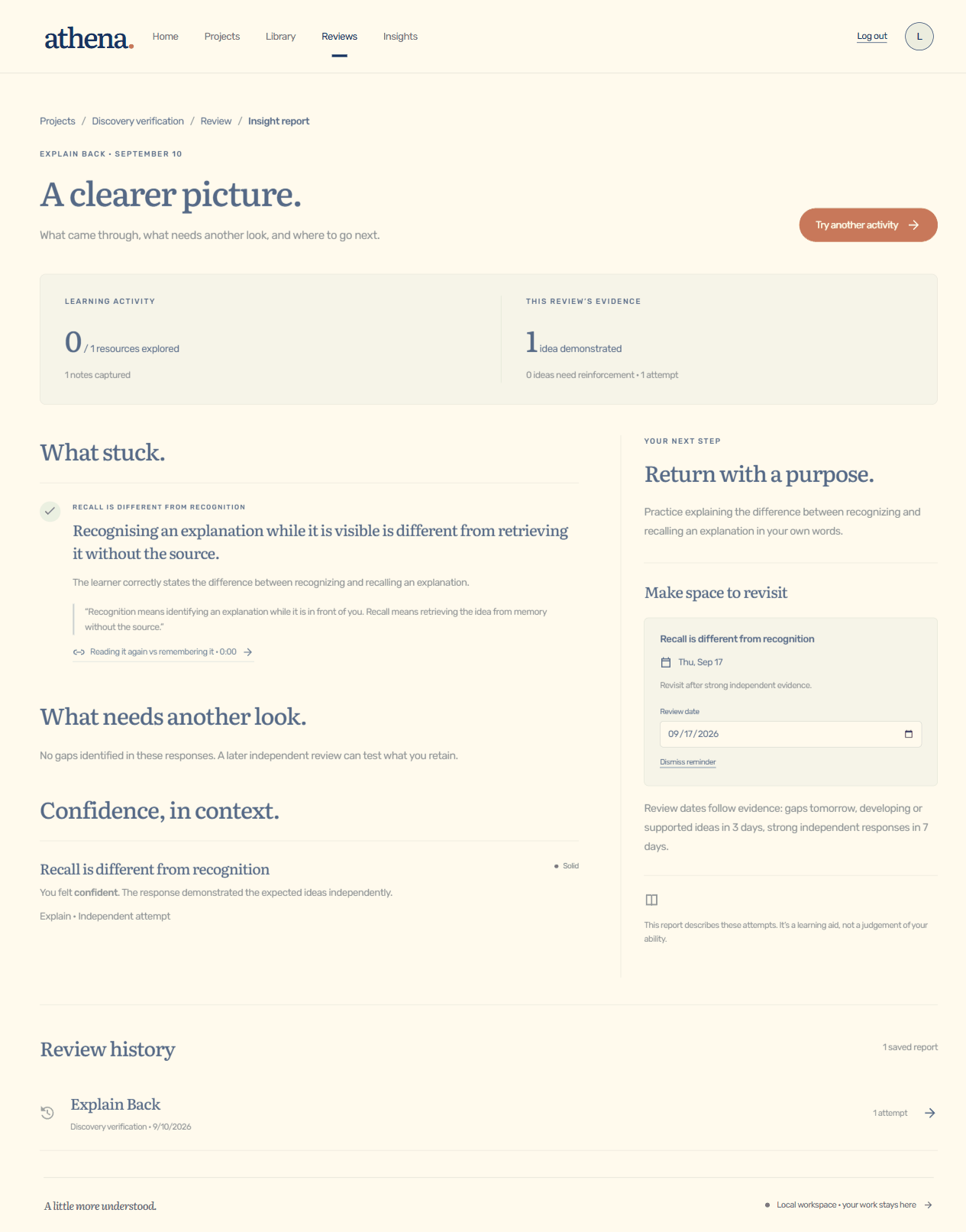
Athena's Explain Back report: the learner's response, what it demonstrated, the gap, and the supporting passage.
Explain BackAn attempt made without the source. The report records what was demonstrated, what is missing, and the exact passage that would fix it.
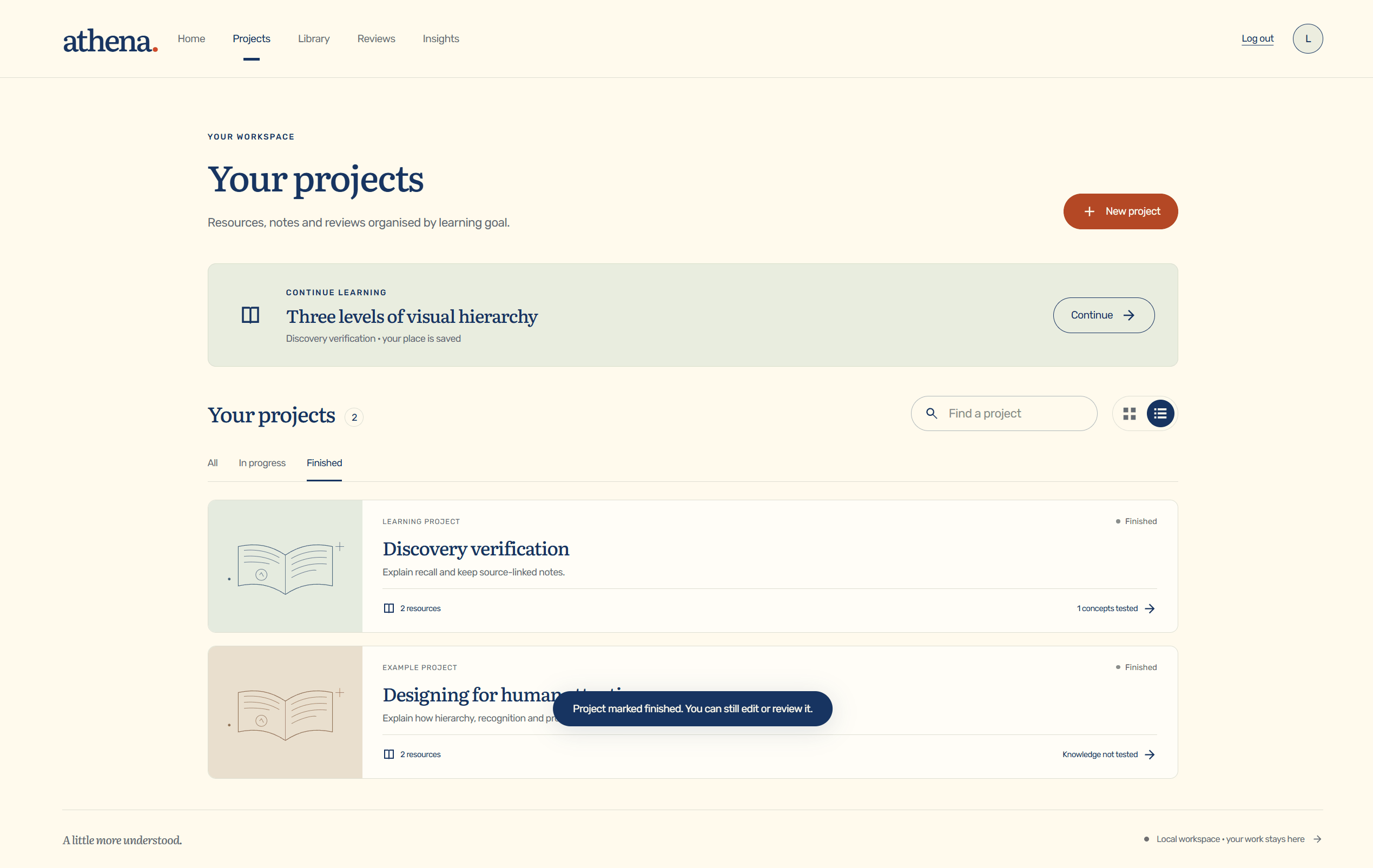
Athena's project dashboard: learning activity and knowledge evidence reported as separate records.
Insight reportActivity and knowledge evidence are reported apart, and concepts that were not demonstrated come back earlier.

Captured from the working prototype. The linked demo is intentionally disconnected and runs on seeded browser-local data. The local build runs the real Express, SQLite and model path.

The situation

Understanding something while consuming it does not prove a learner can recall, explain or apply it later.

The project started as a broad look at digital learning and narrowed onto one contradiction. Learners assemble their own systems from tools that each solve one part: video for explanation, AI for simplification, search and forums for other views, PDFs for depth, courses for structure, notes for memory.

The team ran 1-on-1 interviews, structured responses across disciplines, a focus group of six, and affinity mapping. Five findings kept coming back: understanding is not the same as retention; learners used AI for quick explanations and still checked them; having more resources made continuity harder; autonomy mattered; and active use was what revealed learning.

We treated recurring patterns as design evidence, not as population-level claims. The sample was small and was never asked to prove that Athena works.

What it is

This was a four-person team project with Nishtha, Anushrutha and Trisha. My part was research synthesis, product and interaction design, and the prototype build.

We designed one workspace where a project holds its resources, notes, review and feedback, with three review modes. The feedback names what was demonstrated and what is missing, down to the exact source passage.

The prototype is a real working build, not a click-through, and it was checked against all eighteen of its own acceptance criteria.

'It makes sense' is not the same as 'I know it.'

What changed during the build

Deciding that review lived inside the project, instead of in a separate quiz app, shaped everything else: feedback can point back to the exact passage it came from, and help arrives after an attempt instead of before it.

Building it also forced the honest boundary. The prototype works and its criteria passed, but nobody has shown that learners retain more because of it. That test is designed and not yet run.

The reasoning

Progress should not stop at watched, saved, or completed.

The turn

  1. Where it started

    Learning products measure progress by what the learner has consumed: lessons finished, resources saved, streaks kept.

  2. What changed

    Completion and familiarity produce a convincing feeling of progress. Two learners put it plainly: watching courses can feel productive without much learning, and practice beats watching or reading.

  3. Where it landed

    Athena adds a moment where the learner produces evidence without looking at the answer, and reports activity and knowledge as two different things.

The record

Decisions and open questions.

Make review part of the project, not a separate quiz

Attach resources, notes, attempts and feedback to one project context instead of building a standalone test product.

The learner never rebuilds context across tools, and feedback can point back to the exact passage it came from.

Report activity and mastery separately

Never convert completion, confidence or a self-rating into a mastery percentage; show the evidence state as Solid, Developing, Review or Not Tested.

The workspace can say what is actually known, including 'not tested yet', instead of implying progress from use.

Ground the assistant by default

Answer from project material with source locations, reject unknown citations, and make outside knowledge an explicit opt-in.

The first step gets easier without the learner's thinking being replaced, and nothing is presented as unquestioned authority.

Built and working
  • A working prototype: React 19 front end, Express 5 and SQLite server, local Ollama models, Zod-validated source and citation checks.
  • All 18 acceptance criteria verified, with 11 core tests and 10 API integration checks passing.
  • Three review modes implemented (Explain Back, Cue Cards and Apply It) with concept-level spaced review.
  • Ingestion for text, article, PDF, DOCX and video sources; grounded answers with exact source navigation; context-linked notes.
  • Activity-versus-knowledge reporting, Focus Mode, keyboard accessibility, and recovery from model outages and malformed output.
  • A disconnected public demo build for inspection.
Not yet proven
  • No learning-outcome study has been run: no effect size, retention gain or delayed-recall result is claimed.
  • The research sample was small: a focus group of six plus interviews. It was treated as design evidence, not as a measured population.
  • The public demo is intentionally disconnected and uses seeded browser-local data. The local build is where the real Express, SQLite and Ollama path runs.
  • The feedback shown in the interface and on this page is an illustrative scenario, not a participant quotation or a measured learning outcome.

Next test

Test delayed recall, not the demo.

A first step needs no study budget: watch a few learners use the review experience once and note where the Explain Back workflow or its wording confuses them. Then run the prototype with learners over several weeks and measure whether reviewed weak concepts are still retrievable later, and whether learners act on the gaps the report names.

What would countGood news would be delayed recall improving on concepts that came back through review. The opposite result is also worth reporting: if learners ignore the weak concepts, or review feels like a burden, the loop needs changing.

Athena is a four-person team project (Team Folio: Tanishk, Nishtha, Anushrutha, Trisha). This case reports the team's research and design decisions. The linked demo is an intentionally disconnected build on seeded browser-local data. No learning outcome, usage data or adoption is claimed, and the interface feedback shown is an illustrative scenario.

Next

Athena replaces watched-and-completed with evidence. Daynero replaces the monthly budget with today's number.

Personal finance appDaynero

A personal finance app for people earning their first salary. It brings income and expenses together to answer one question: How much can I safely spend today? Currently in development.

Also: Invisible Interfaces →

← Back to projects